How Long Does the Moon Take to Reach New Moon Again
The New Moon is when the Lord's day and Moon are aligned, with the Sun and Earth on opposite sides of the Moon.
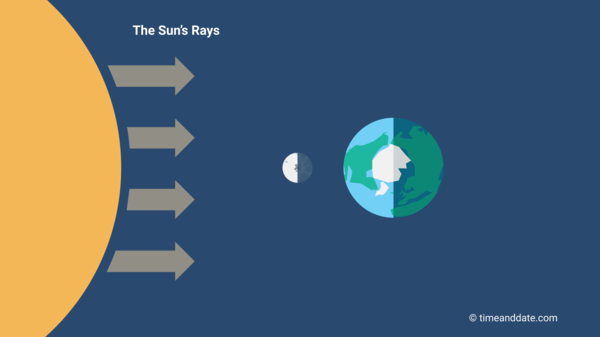
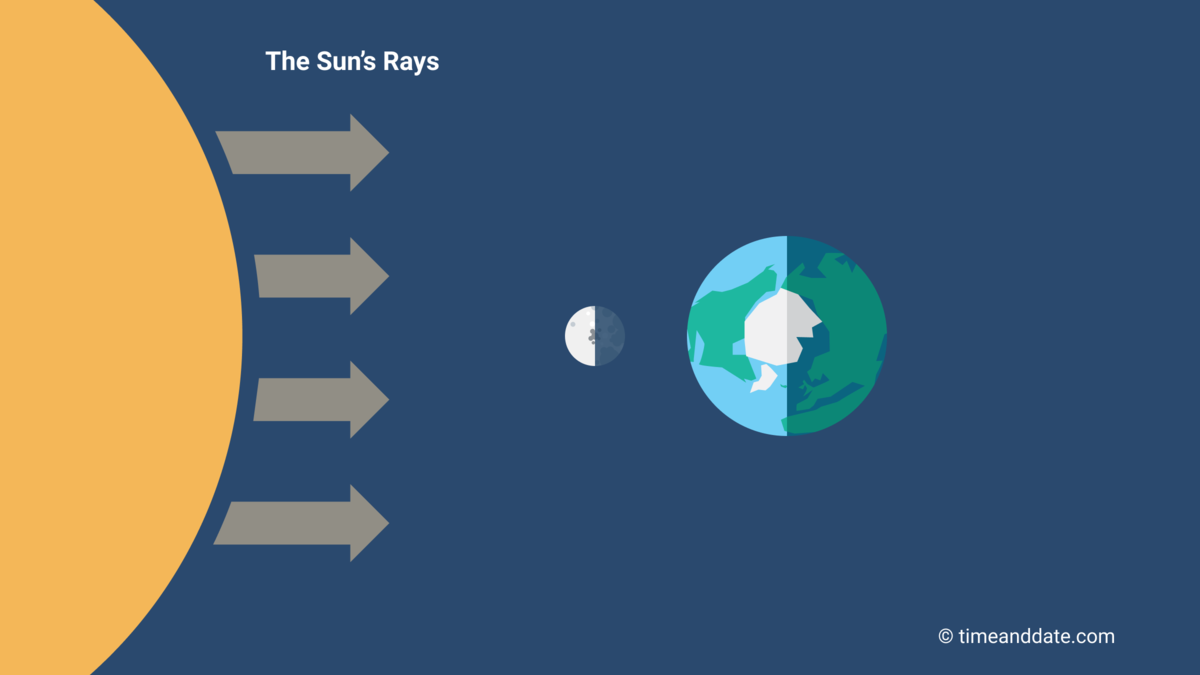
At New Moon, the Sun, the Moon, and World are in alignment.
©timeanddate.com
Next New Moon
one Mei 2022, 03:28
Previous New Moon
i April 2022, 13:24
Times for the New Moon vary by time zone. Times and dates are based on the local time in Jakarta. Change location
Nosotros Can't See the New Moon
At that place are two reasons why nosotros can't see the New Moon:
- The alignment of the Sun, the Moon, and Earth leaves the side of the Moon that faces Earth in darkness. This is called a conjunction or Syzygy.
- The New Moon is up in the daytime sky. It rises and sets around the aforementioned fourth dimension as the Lord's day, bringing information technology too close to the Sun'south glare to be seen with the naked eye.
For all that, yet, there is 1 special occasion when we tin can run into a New Moon: during a solar eclipse. In fact, this is the just occasion that the New Moon is 'perfect'. The Moon'southward orbit around the Earth is slightly tilted, which means that—more than often than not—the Sun, Moon and Earth are non perfectly aligned at New Moon. With specialist equipment, it is sometimes possible to observe a vanishingly thin lunar crescent in the blue sky at the precise moment of New Moon.
Moon phases in your urban center
The Moon: Our natural satellite
A Good Night for Stargazing
As New Moon nights are dark, they are often the best time to view other celestial objects like planets, meteor showers, and deep sky objects such every bit star clusters, nebulae, and galaxies.
Half of the Moon's surface is always illuminated past directly sunlight, except during lunar eclipses when Earth casts its shadow on the Moon. Just how much of that light we tin see from Earth varies every day, and we telephone call this a Moon phase.
Is there a dark side of the Moon?
Higher Tides at New Moon
The greatest difference between high and low tide is effectually New Moon and Full Moon. During these Moon phases, the Moon and the Dominicus's gravitational forces combine to push the ocean's water in the same direction. These tides are known as leap tides or king tides.
Religious and Cultural Significance
The Moon guides the dates of many religious and cultural holidays around the world. February's New Moon marks the first of the Lunar Yr in the Chinese Calendar.
About a day after the New Moon conjunction, the Moon becomes visible once more. The initial catamenia, as only the thinnest sliver of a Crescent Moon becomes visible, used to exist chosen New Moon, while the darkest stage was chosen Dark Moon.
This traditional definition of the New Moon is still in use in some cultures, defining the get-go of the months in the Islamic calendar.
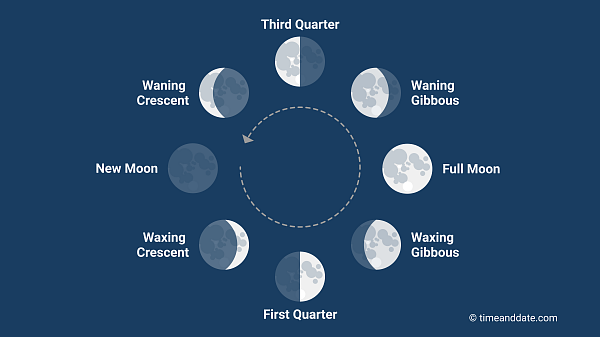
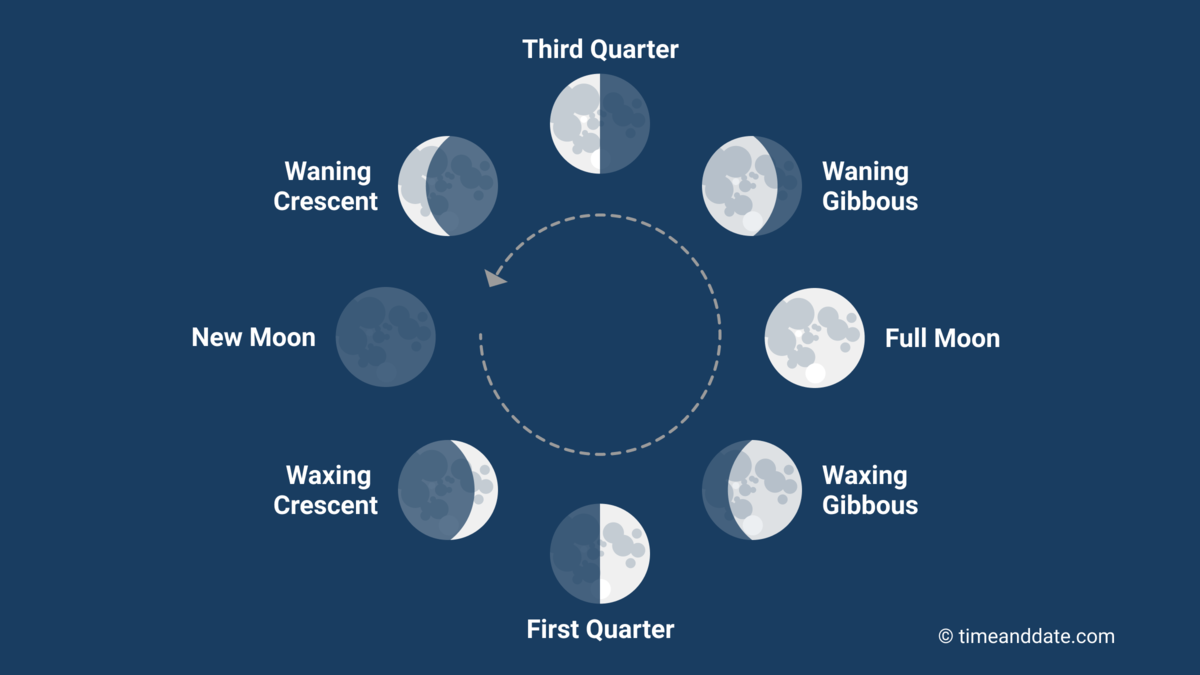
Information technology takes effectually 29.five days to motion through the eight Moon phases.
©timeanddate.com
Get-go Primary Moon Phase
In western civilization, we divide the lunar calendar month into 4 primary and four intermediate Moon phases.
The New Moon is the start primary Moon phase. The next three are the Kickoff Quarter Moon (One-half Moon), the Full Moon, and the Third Quarter Moon (Half Moon).
In addition, at that place are four intermediate Moon phases; the Waxing Crescent Moon, the Waxing Gibbous Moon, the Waning Gibbous Moon, and the Waning Crescent Moon.
New Moon Symbol in Calendars

The symbol for New Moon in modernistic calendars is a filled, black circle.
The other chief Moon phase symbols in calendars:
 = First Quarter,
  = Total Moon,
  = Third Quarter
Agenda with Moon phases
Causes Solar Eclipses
Two to three times a year, the New Moon phase coincides with the Moon reaching the lunar nodes of its orbit. The lunar nodes are the points where the Moon'south orbit crosses the ecliptic, which is the Sun's path, seen from Earth. Then, the New Moon comes between the Globe and the Sunday and becomes visible as a silhouette in forepart of the Lord's day.
Solar eclipses can simply happen in the hours around New Moon. Lunar eclipses, on the other hand, merely occur at Full Moon.
When Is the Next Solar Eclipse?
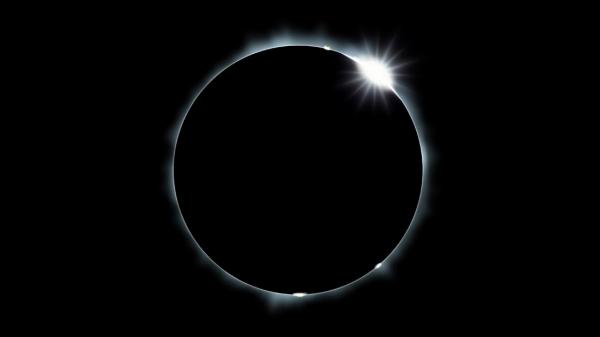
A total solar eclipse is a New Moon eclipsing the Sun.
©bigstockphoto.com/JohanSwanepoel
A Black Moon Is a New Moon
Most years have 12 New Moons, one each month. But our calendar is not perfectly synchronized with astronomical events. Therefore, every now then, a year has 13 New Moons. When this happens, at least one of those New Moons is a Black Moon.
Super and Micro New Moon
The Moon orbits Earth on an elliptical path, so its distance from Earth changes during a lunar month.
The bespeak closest to Earth is called perigee, and the farthest point is known every bit apogee. When the New Moon is close to the perigee, information technology is known equally a Super New Moon.
A Micro New Moon, on the other hand, is when it is uttermost from Earth, at apogee.
Source: https://www.timeanddate.com/astronomy/moon/new-moon.html
0 Response to "How Long Does the Moon Take to Reach New Moon Again"
Post a Comment